
A Dominican Moment
My unlikely journey into the Catholic Church: Part 2

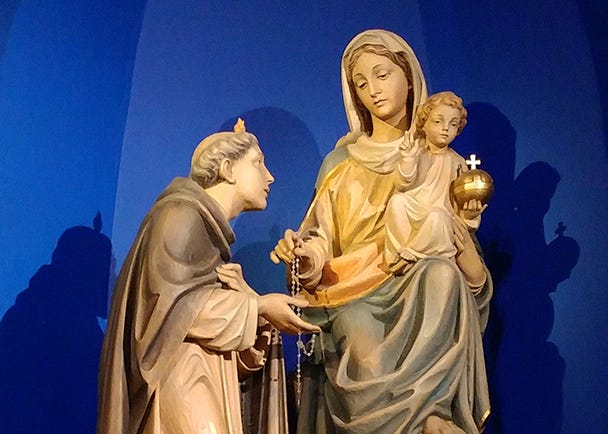
I never expected to become a Catholic.
In fact, I was actively anti-Catholic—until God, with a sense of humor, pulled me in anyway. First through the Rosary… then fully through St. Thérèse of Lisieux and her Story of a Soul.
On a gloriously sunny feast of St. Albert the Great in 1990, I was received at a Mass in the Dominican House of Studies (DHS) in Washington, DC, by Fr. Norman Fenton, OP. No doubt this was a relief to Father, who had patiently put up with my cluelessness and defensive questions during the months God was trying to make a Catholic out of me. Now, I was officially in.
When my mother told the Presbyterian minister who baptized me, he said, “Well, at least she’s something.”
Not long after, I worried: What if I slip back?
That’s when I learned about third orders—vocations for lay people, married and single, living family and work life: Dominican, Franciscan, Jesuit, and Carmelite among them.
Dominican? We’ll see.
Franciscan? Franciscans are very nice people and I’m not that nice, so that was probably out.
Jesuit? I was born on the feast of St. Ignatius Loyola, but the action-oriented Jesuit vocation would only encourage borderline work addiction. Carmelite sounded like the best choice.
Two attempts to connect with a Carmelite group fell through. Hmmm…I had a Dominican spiritual director. Entered the Church in the Dominican seminary. On the feast of the Dominican St. Albert.
Hint taken.
Making of a Dominican
At my first Lay Dominican meeting, I knew.
These were people who loved truth, and lived it. Deep prayer. Clear thinking. Real action. Martha and Mary—together. As an inveterate Martha (and Mary wanna-be), I realized this was the perfect balance: action flowing out of a deep connection with God in prayer and contemplation of the Truth.
Soon after conversion, I signed up for a five-year study group at the DHS reading the 2,400 pages of the Summa from front to back. This affirmed my Dominican vocation. The clarity and love of God coming through St. Thomas’ writing brought tears to my eyes and melted my heart.
Through subsequent years of studying the Catechism and encyclicals, something became undeniable: The more I understood the Faith, the more it held together. And the more I learned about God, the more I loved Him.
The Dominican Moment
Today, faithful communities of Dominican nuns in several states and Dominican Friars in the Eastern Province, where I live, are being flooded with so many vocations that their novices sometimes live two to a room because buildings can’t be built fast enough for the influx. Lay Dominican vocations are blooming, too.
It’s been called a “Dominican moment” because the culture of lies and death is ascendent, just as it was in St. Dominic’s time, and we need the same remedy: Truth.
When St. Dominic de Guzmán (1170-1221) preached to the Albigensian heretics of southern France, he preached the gospel of life and the goodness of the material world as a creation of God, who is goodness itself.
The Albigensians had adopted a form of first-century Gnosticism (which showed up as Manichaeism in the time of Augustine), believing that there were two gods of equal power: a “good” god of the spiritual world and an “evil” god of the material world.
Therefore, if matter was evil, it was just fine to commit suicide or do anything with your own body because the body was evil anyway, so you might as well forget marriage, have orgies, and even kill your children if they got in the way of your fun.
Sound familiar?
Finding a “Preaching” Style
Dominicans are known as the Order of Preachers. Lay Dominicans “preach” according to their gifts and circumstances. For years, I shared the Good News by creating calligraphic artwork on spiritual themes pointing to the glory of God and the joy of Christian life.
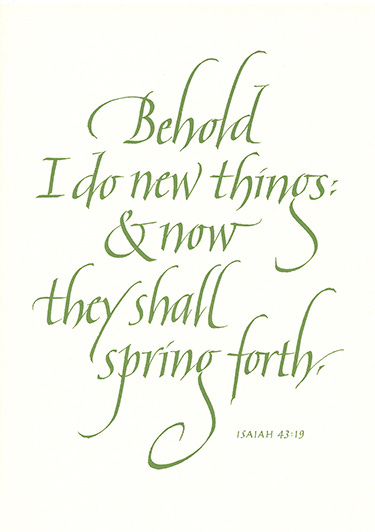
Then, one day as I lounged in a cushy chair in a retreat house library, God planted a new seed that grew into my current calling.
Flipping through The Catholic Encyclopedia, I saw the word “hypocrisy.” The definition was, “Pretending to have a virtue we don’t have.” I asked myself, “Why didn’t I know that?”
One-third of the Summa is on virtue and vice. Still, I couldn’t define “hypocrisy” off the top of my head. And if I couldn’t do it, how much more those who don’t even care about virtue?
If they knew what the virtues were and their life-changing benefits, would they strive to live differently?
Eventually, I realized God was calling me to let others know the virtues – and the benefits of cultivating them. After a decade of study, prayer, and Dominican formation, I was ready, with God’s help, for my new apostolate.
Universal Call
The work of St. Josemaría Escrivá promoted a saintly life for lay people. Dominican theologian Servais Pinckaers helped reclaim virtue as the way to be happy instead of being just a list of do’s and don’ts. This paved the way for Vatican II’s universal vocation to holiness (see Lumen Gentium, chapter 5).
By the time I started teaching the virtues in 2014, the lay call to holiness was strong in Catholic thinking. My mission was to help people grow in virtues like patience, forgiveness, and gratitude, which make the opposite vices lose their grip in a way that feels natural. Not through force, but through transformation.
Since 2019, I have focused on helping people connect more closely with God in prayer, which is the foundation of growth in virtue.
My Dominican vocation is central to maintaining a joyful commitment to my own spiritual growth. The example and support of my Dominican brothers and sisters has been crucial as we walk together to heaven – bringing as many people with us as possible by God’s grace – following in the footsteps of St. Dominic.
If the Lay Dominican vocation sounds intriguing, locate a Lay Dominican group near you at laydominicans.org/connect/fraternity-locator
Thanks for sharing your journey!